
No-Mow Garden Design: Lawn Alternatives That Thrive
Explore no-mow garden design with lawn alternatives that thrive, including clover lawns, creeping thyme, moss gardens, meadow patches, and ground covers.
No-Mow Garden Design: Lawn Alternatives That Thrive
The traditional lawn — that expanse of closely mown, uniformly green grass — is one of the most ecologically costly elements in any garden. It requires regular mowing (producing noise and emissions), frequent watering (often the largest single water use in a household), chemical inputs (fertilisers, herbicides, and pesticides), and provides almost nothing in return for wildlife. It is, in ecological terms, a green desert.
The no-mow movement is changing this. Across the world, gardeners are discovering that there are beautiful, practical alternatives to the conventional lawn that require less maintenance, use less water, support far more wildlife, and look better doing it. From flowering clover lawns to fragrant thyme carpets, from wildflower meadows to moss gardens, the alternatives are as varied as they are rewarding.
Why Rethink Your Lawn?
Before exploring alternatives, it is worth understanding why conventional lawns are problematic:
- Mowing frequency: A typical lawn needs mowing every one to two weeks through the growing season — twenty to thirty times per year.
- Water consumption: Lawns are the thirstiest element in most gardens, consuming 50 to 75 percent of all garden water.
- Chemical dependency: Conventional lawn care often involves synthetic fertilisers, selective herbicides, and pesticides that harm soil biology and wildlife.
- Ecological emptiness: A monoculture grass lawn supports almost no insect life, provides no nectar or pollen, and offers minimal habitat.
- Carbon footprint: Petrol mowers, manufactured fertilisers, and irrigation all contribute to a lawn's carbon footprint.
None of this means you need to eliminate every blade of grass. The key is to reduce lawn to where it is genuinely useful — for play, pets, and walking — and replace decorative lawn with alternatives that offer more beauty for less input.
"The question is not whether you need green ground cover. The question is whether that ground cover needs to be a closely mown monoculture of grass."
Clover Lawns
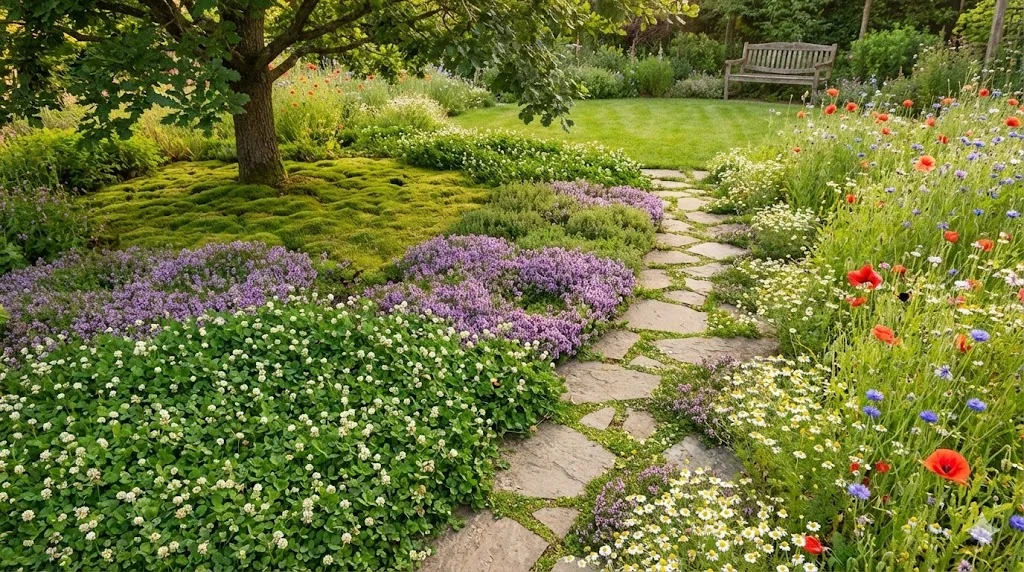
Clover is arguably the best all-round lawn alternative. White clover (Trifolium repens) was traditionally included in lawn seed mixes before the invention of selective herbicides, which killed it alongside other "weeds."
Why Clover Works
- Stays green in drought: Clover has deeper roots than grass and remains green when lawns turn brown.
- Fixes nitrogen: Clover converts atmospheric nitrogen into soil-available form, feeding itself and surrounding plants. No fertiliser needed.
- Supports pollinators: White clover flowers provide nectar for bees from May to September.
- Low mowing: Clover grows lower than grass and can be mown much less frequently — once a month or even less.
- Tolerates foot traffic: Micro-clover varieties are particularly resilient underfoot.
- Outcompetes weeds: A dense clover lawn suppresses most weeds naturally.
How to Establish a Clover Lawn
- Overseed existing lawn: Scarify the lawn in autumn, scatter micro-clover seed, and water in. The clover will establish among the grass and gradually dominate.
- Start from scratch: Prepare soil, scatter clover seed mixed with a small amount of fine grass seed, and keep watered until established.
- Micro-clover varieties: 'Pipolina' and 'Pirouette' are specifically bred for lawns — smaller leaves, lower growth, and denser coverage than wild white clover.
Maintaining a Clover Lawn
- Mow monthly at a height of 5 to 8 cm (much higher than conventional lawns).
- No fertiliser needed — clover provides its own.
- No herbicides — they would kill the clover.
- Water only during extreme drought — clover tolerates dry conditions well.
Creeping Thyme
Creeping thyme (Thymus serpyllum and Thymus praecox) creates a fragrant, flowering ground cover that releases its scent when walked upon.
Benefits
- Fragrant: Stepping on thyme releases essential oils — a sensory delight.
- Flowering: Carpets of pink, purple, or white flowers in June and July attract bees and butterflies.
- Drought-tolerant: Once established, thyme needs almost no watering.
- Evergreen: Retains its tiny leaves through winter.
- Very low: Grows only 2 to 5 cm high. No mowing needed.
Limitations
- Low traffic tolerance: Creeping thyme handles light foot traffic but not heavy use or sports.
- Slow to establish: Takes one to two growing seasons to form a dense carpet.
- Needs good drainage: Thyme struggles in heavy, waterlogged clay soils.
Best For
Pathways, stepping stone surrounds, edges of seating areas, small courtyard gardens, and any area where fragrance and beauty matter more than heavy-duty resilience.
Moss Gardens
Moss is the ultimate low-maintenance ground cover — it needs no mowing, no feeding, no watering (in damp climates), and stays green year-round.
Why Moss Works
- Zero maintenance: Moss does not grow tall, does not need cutting, and does not need feeding.
- Thrives in shade: Perfect for north-facing gardens and under trees where grass struggles.
- Beautiful texture: The velvety surface of a moss lawn is extraordinarily appealing — soft, even, and luminous green.
- No soil compaction: Moss has no roots in the traditional sense, so it does not compact soil.
How to Encourage Moss
- Remove grass competition: Moss cannot compete with vigorous grass. Reduce grass by reducing light and fertility.
- Increase shade: Moss thrives in shade. Trees, structures, or fabric shade can help.
- Keep acidic: Moss prefers acidic soil (pH below 6). Do not lime.
- Reduce drainage: Moss likes moisture. In dry areas, it works best in shaded, sheltered spots.
- Transplant patches: Collect moss from areas where it already grows (with permission) and press it onto damp, prepared soil.
Best For
Japanese-style gardens, shaded courtyards, north-facing areas, woodland gardens, and contemplative spaces where texture and calm are priorities.
Wildflower Meadow Patches
Converting part of your lawn to a wildflower meadow is one of the most ecologically beneficial changes you can make in any garden.
Types of Meadow
- Annual meadow: Sown each year with annual wildflower seeds — cornflowers, poppies, corn marigolds, corn chamomile. Spectacular colour in the first year but needs resowing annually.
- Perennial meadow: A mix of perennial wildflowers and native grasses that establishes over two to three years and then persists indefinitely. Less showy than annual meadows initially, but more sustainable long-term.
How to Create a Wildflower Meadow
- Reduce fertility: Wildflowers thrive on poor soil. Rich garden soil favours grasses over flowers. Remove the top 5 to 10 cm of soil, or grow yellow rattle — a semi-parasitic plant that weakens grasses and allows wildflowers to establish.
- Choose appropriate seed: Use a mix suited to your soil type and region. Native wildflower mixes are always best for biodiversity.
- Prepare the ground: Remove existing vegetation, rake to a fine tilth, scatter seed, and press in with a roller or by walking.
- Manage carefully: Cut once in late summer (August–September) after flowers have set seed. Remove cuttings to prevent soil enrichment.
For a comprehensive approach to meadow creation, including plant selection and long-term management, see our full guide on wildflower garden design and meadow planting.
The "Mown Path" Design
The most elegant way to incorporate a meadow into a garden design is the mown path approach: leave the meadow long and mow clear, curving paths through it. This creates a deliberate, designed look — signalling that the long grass is intentional — while maximising the wildlife benefit.
"A mown path through a wildflower meadow is the most beautiful and sustainable design element in any garden. It costs nothing and gives everything."
Ground Cover Alternatives
Beyond the big three (clover, thyme, moss), a wide range of ground cover plants can replace lawn in specific situations.
For Sun
- Chamomile (Chamaemelum nobile 'Treneague'): The classic non-flowering chamomile lawn. Apple-scented, soft, and beautiful. Needs good drainage and low traffic.
- Corsican Mint (Mentha requienii): Tiny, flat, intensely mint-scented. Delicate but beautiful between paving stones.
- Lippia nodiflora (Phyla nodiflora): Extremely low-growing, drought-tolerant, and produces tiny flowers. Good for warm climates.
- Dichondra repens: Round-leaved, soft, evergreen ground cover. Tolerates light foot traffic.
For Shade
- Ajuga reptans (Bugle): Purple-bronze foliage with blue flower spikes in spring. Spreads quickly in shade.
- Vinca minor (Lesser Periwinkle): Evergreen, with purple-blue flowers. Tough and spreading.
- Pachysandra terminalis: Dense, glossy evergreen ground cover for deep shade under trees.
- Liriope muscari: Grass-like, with purple flower spikes in autumn. Evergreen and resilient.
- Native woodland species: Violets, primroses, and wood anemones create a naturalistic ground cover under deciduous trees.
For Wet Areas
- Soleirolia soleirolii (Mind-your-own-business): Tiny-leaved, mat-forming, loves damp shade.
- Lysimachia nummularia (Creeping Jenny): Golden or green foliage, spreading rapidly in moist soil.
- Raoulia australis: Silver, tight-knit mat. Interesting texture for damp spots.
Designing Your No-Mow Garden
The transition from lawn to alternatives works best when it is designed rather than haphazard. Consider these design strategies:
Keep Functional Lawn
Retain mown grass where you genuinely use it — a play area for children, a path to the shed, a flat surface for garden furniture. Every other area is a candidate for alternatives.
Zone Your Ground Covers
Use different alternatives in different areas based on conditions and use:
- High-traffic paths: Chamomile or creeping thyme between stepping stones.
- Play areas: Clover lawn (tolerates foot traffic, stays green).
- Shady areas under trees: Moss or shade-loving ground covers.
- Sunny decorative areas: Wildflower meadow or thyme lawn.
- Borders and edges: Dense ground cover plants that suppress weeds and require no mowing.
Create Transitions
The boundary between mown lawn and no-mow areas should feel intentional. Use:
- Defined edges (metal, stone, or timber edging)
- Mown paths through meadow areas
- Gradual transitions from short to medium to long vegetation
- Strategic placement of stepping stones
When you design your garden layout, you can map out different ground cover zones, plan transitions, and ensure the overall design looks cohesive and intentional.
The Ecological Benefits
Replacing conventional lawn with alternatives delivers immediate ecological benefits:
- Pollinator support: Clover, thyme, and wildflower meadows provide nectar and pollen that mown grass cannot.
- Insect habitat: Longer vegetation provides shelter and breeding sites for beetles, spiders, and other beneficial insects.
- Bird food: Seed-bearing wildflowers and the insects they support feed garden birds.
- Soil health: Deeper-rooted alternatives improve soil structure, increase organic matter, and support soil organisms.
- Water conservation: Alternatives like clover, thyme, and meadow require little to no irrigation.
- Carbon sequestration: Longer vegetation and deeper roots store more carbon than closely mown grass.
Getting Started with No-Mow
You do not need to remove your entire lawn. Start with one of these three approaches:
- Stop mowing one area. Choose a section of lawn — even just 2 x 2 metres — and let it grow from March to September. Scatter yellow rattle seed in autumn to weaken the grass, and wildflower seed the following spring. You will be astonished at what emerges.
- Overseed with clover. Scarify a section of lawn, scatter micro-clover seed, and water in. Within a year, you will have a green, flowering surface that needs far less mowing and no fertiliser.
- Plant thyme between stepping stones. If you have a paved path with gaps, plant creeping thyme in the joints. It fills in quickly, flowers beautifully, and releases fragrance every time you walk on it.
The no-mow movement is not about abandoning lawn care — it is about reimagining what ground cover can be. The alternatives are more beautiful, more sustainable, and more alive than anything a mower can produce. For the broader sustainable gardening context, visit our sustainable garden design guide.
Garden Design Team
Expert garden designers sharing tips, inspiration, and practical advice for creating beautiful outdoor spaces.
Explore professional garden design
Gardenly3D is a paid professional garden-design application. See plans for included capabilities and availability.
Join the waitlistRelated articles
Carbon-Positive Garden Design: Sequestering Carbon at Home
Design a carbon-positive garden that sequesters carbon through tree planting, biochar, peat-free growing, reduced hardscape, and soil health strategies.
Composting and Soil Health for Garden Designers
Master composting and soil health for better garden design with guidance on the soil food web, composting methods, mulch types, no-dig gardening, and more.
Permaculture Garden Design: Principles and Practices
Learn permaculture garden design principles and practices including food forests, guilds, zones, swales, polyculture, and closed-loop sustainable systems.