
Vegetable Garden Design: Productive and Beautiful
Design a vegetable garden that's both productive and gorgeous. Master raised beds, companion planting, succession sowing, and the French potager style.
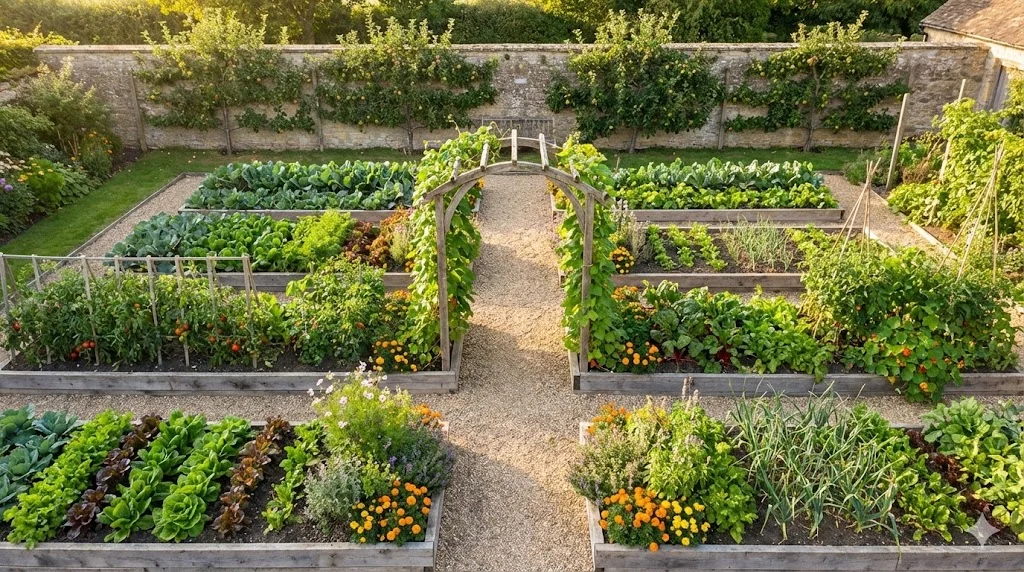
There is a quiet satisfaction in stepping outside your back door and picking dinner. A handful of sun-warmed tomatoes, a bunch of cut-and-come-again lettuce, a sprig of basil still fragrant with morning dew. But the best vegetable gardens offer more than produce. They are beautiful spaces in their own right, places where neat rows of feathery carrot tops meet the bold architecture of climbing beans, where marigolds blaze between cabbages and espaliered apple trees frame the view. A well-considered vegetable garden design proves that productivity and beauty are not opposites but natural partners.
Whether you dream of a formal French potager, a practical allotment-style plot, or something uniquely your own, the principles in this guide will help you create a kitchen garden layout that feeds your household generously while looking gorgeous in every season.
Potager vs. Allotment: Two Approaches to Vegetable Garden Design
Before you dig a single bed, it helps to decide which broad tradition speaks to you. Both produce abundant harvests, but they organise space very differently.
The French Potager
The potager, or ornamental kitchen garden, treats the vegetable plot as a formal garden room. Geometric raised beds arranged symmetrically around a central focal point, perhaps a sundial or standard rose, create a structured framework. Paths of gravel, brick, or stone divide the beds into neat compartments. Edible plants are chosen as much for their visual qualities as their flavour: ruby chard for its crimson stems, purple basil for contrast, nasturtiums for their trailing habit and vivid orange flowers.
The potager tradition goes back to the great kitchen gardens of French chateaux, most famously the Potager du Roi at Versailles. But the style scales beautifully. Even a modest four-bed arrangement measuring 3 by 3 metres (10 by 10 feet) can capture the potager spirit if the geometry is crisp and the planting is thoughtful.
The Allotment or Working Plot
The allotment approach prioritises maximum yield. Long, straight rows make sowing, weeding, and harvesting efficient. Beds are typically at ground level, divided by simple trampled-earth paths. The beauty here is honest and functional: the deep green of brassica leaves, the geometric precision of onion sets in a ruler-straight line, the improbable height of a Jerusalem artichoke hedge.
Most home vegetable gardens borrow the potager's emphasis on structure while keeping the allotment's practical efficiency. For a broader look at how edible gardens fit within the wider world of garden styles, see our complete guide to garden design styles.
Raised Bed Design: The Foundation of the Kitchen Garden
Raised beds are the single most popular element in modern vegetable garden design, and for good reason. They offer better drainage, warmer soil in spring, easier access for sowing and weeding, and a strong visual framework that instantly makes a vegetable plot look intentional.
Dimensions That Work
Width: Keep beds no wider than 1.2 metres (4 feet) so you can reach the centre comfortably from either side. If a bed is accessible from one side only, limit it to 60 centimetres (2 feet).
Length: A length of 2.4 metres (8 feet) is a practical sweet spot, though anything from 1.2 to 3.6 metres (4 to 12 feet) works well.
Height: A minimum of 15 centimetres (6 inches) gives noticeable benefits. For root vegetables or gardeners who prefer to avoid bending, 30 to 45 centimetres (12 to 18 inches) is ideal.
Materials
Untreated softwood (larch, cedar, Douglas fir) is the most popular choice, weathering to silver grey and lasting five to ten years. Hardwood (oak, chestnut) lasts decades. Stone, brick, or block creates permanent, handsome beds that suit a potager layout and retain heat for warmth-loving crops. Galvanised steel and corten steel have become fashionable, with corten developing a warm rust patina that looks striking against green foliage. Avoid pressure-treated timber near food crops.
Spacing Between Beds
Allow at least 45 centimetres (18 inches) between beds for walking. If you use a wheelbarrow, 60 centimetres (24 inches) is the minimum. Main paths should be 90 to 120 centimetres (3 to 4 feet) wide.
Companion Planting: Growing Friends Together
Companion planting is one of the oldest and most rewarding aspects of vegetable garden design. Certain plants grow better when placed near one another, whether because one deters the other's pests, provides physical support, or enriches the soil.
Classic Pairings
- Tomatoes and basil. Basil repels aphids and whitefly while the two crops share the same warm, sunny conditions.
- Carrots and onions. The scent of onions masks the smell of carrots from carrot root fly, and vice versa.
- Sweetcorn, beans, and squash (the "Three Sisters"). Sweetcorn provides a living pole for climbing beans; beans fix nitrogen; squash shades the ground with broad leaves, suppressing weeds.
- Lettuce and tall crops. Lettuce bolts quickly in full sun. Plant it in the partial shade of taller neighbours to extend the harvest.
- Brassicas and aromatic herbs. Rosemary, sage, and thyme planted around cabbages and kale confuse cabbage white butterflies with their strong scent.
Plants to Keep Apart
Fennel inhibits the growth of many vegetables and is best given its own corner. Potatoes and tomatoes share blight vulnerabilities and should be separated. Onions and garlic can suppress the growth of beans and peas.
If you want to explore integrating herbs and edibles into the wider garden beyond the vegetable plot, our guide to edible landscape design covers the broader possibilities.
Succession Planting for a Continuous Harvest
One of the most common disappointments in kitchen gardening is the feast-and-famine cycle: a mountain of lettuce in June, nothing in August. Succession planting solves this by staggering sowings so that fresh crops mature continuously.
Instead of sowing an entire packet of lettuce seed in one go, sow a short row every two to three weeks from early spring through late summer. As you harvest one batch, the next is already growing. The same approach works for radishes, spinach, spring onions, beans, and beetroot.
Relay planting takes succession further. When early spring peas finish, clear the bed and sow summer French beans. When those end in early autumn, plant garlic or overwintering broad beans. A single raised bed can produce three distinct harvests in one year. Laying out your planting calendar visually makes it far easier to spot gaps and overlaps, ensuring every bed earns its keep.
Crop Rotation: Keeping the Soil Healthy
Growing the same crop family in the same bed year after year depletes nutrients and allows soil-borne pests to build up. A simple four-year rotation solves this:
- Legumes (peas, beans, broad beans). Fix nitrogen, enriching the soil for the next group.
- Brassicas (cabbage, broccoli, kale, Brussels sprouts). Heavy feeders that benefit from the nitrogen left by legumes.
- Roots (carrots, parsnips, beetroot, turnips). Prefer soil that has not been freshly manured.
- Solanaceae and cucurbits (tomatoes, peppers, potatoes, courgettes, squash). Heavy feeders; apply compost before planting.
Permanent crops such as asparagus, rhubarb, and perennial herbs sit outside the rotation in dedicated beds.
Vertical Growing: Making the Most of Height
Vertical growing is one of the most effective strategies in any kitchen garden layout, especially in smaller plots. Training plants upward frees ground space and makes harvesting easier.
- Climbing beans on bamboo wigwams, obelisks, or trellis panels.
- Peas on pea sticks, netting, or wire panels.
- Cucumbers trained up strings or a wooden frame produce straighter, cleaner fruit than those sprawling on the ground.
- Squash and small pumpkins on sturdy arches or A-frames, with developing fruit supported in net slings.
- Tomatoes (cordon varieties) tied to stakes or wound around vertical strings.
A row of bean poles arching over a central path creates a living tunnel that is both productive and breathtaking. Espaliered fruit trees turn a wall or fence into a productive vertical surface.
Integrating Flowers for Pollinators and Pest Control
A vegetable garden that includes flowers is more productive, more resilient, and infinitely more beautiful. Flowers attract the pollinators that set fruit on beans, courgettes, and tomatoes, and draw beneficial insects (hoverflies, lacewings, ladybirds) that feed on aphids.
The best flowers for the vegetable garden include marigolds (deter whitefly, suppress nematodes), calendula (attract hoverflies, edible petals), nasturtiums (trap crop for blackfly, edible flowers and leaves), borage (bee magnet, excellent near squash), sunflowers (pollinators and living supports for beans), and lavender along path edges.
Scatter these throughout your beds rather than confining them to a single border. A kitchen garden with flowers woven through every row feels abundant and alive.
Fruit Trees, Espalier, and Soft Fruit
Even a small kitchen garden layout can accommodate fruit if you choose the right form. Espaliered fruit trees, trained flat against a wall, fence, or freestanding wire frame, occupy minimal ground space, are easy to prune and pick, and look magnificent. Apples and pears are the classic choices. Cordon trees can be planted as close as 75 centimetres (30 inches) apart, allowing several varieties in a compact space. Plums, cherries, and peaches respond well to fan training against a warm wall.
For soft fruit, train raspberries on a post-and-wire system, grow blackcurrants and gooseberries as free-standing bushes, and use strawberries as an edging plant along raised bed sides.
Paths, Edging, and the Kitchen Garden Aesthetic
Paths and edging define the structure of a vegetable garden and make the difference between a plot that looks designed and one that merely looks dug. Gravel is affordable and suits both formal and informal layouts. Brick is ideal for a potager, especially in herringbone or basketweave patterns. Bark mulch is a budget option that needs annual topping up.
Crisp edging elevates the whole space. Box hedging is the classic potager choice, though box blight has made many gardeners switch to Ilex crenata, dwarf lavender, or compact rosemary. Steel or corten edging strips give a clean, contemporary line.
Seasonal Planning: Spring Through Winter
A well-planned kitchen garden produces food for eight or nine months of the year.
Spring (March-May): Lettuce, radishes, spinach, peas, broad beans, spring onions, and early potatoes. Protect tender sowings with fleece or cloches.
Summer (June-August): Tomatoes, courgettes, climbing and dwarf beans, cucumbers, peppers, sweetcorn, beetroot, carrots, and chard. Keep succession sowing salads.
Autumn (September-November): Harvest squash and maincrop potatoes for storage. Sow garlic, autumn onion sets, and overwintering broad beans.
Winter (December-February): Harvest leeks, Brussels sprouts, kale, and winter cabbages. Review what worked, order seeds, and prepare beds with compost.
Sketching out your seasonal plan before the growing year begins allows you to experiment with layouts and rotations without wasting a single seed.
Bringing the Kitchen Garden Together
The most satisfying vegetable gardens are those where every element, the geometry of the raised beds, the rhythm of the companion planting, the vertical drama of climbing beans and espaliered fruit, works together to create a space that nourishes both the table and the eye. A kitchen garden layout does not need to be large. Four well-built raised beds, a clear path between them, a climbing frame for beans, a border of marigolds and herbs: this is enough to grow a meaningful amount of food while creating something genuinely beautiful.
Start with the bones: beds, paths, and one or two vertical features. Choose your crops for flavour but also for form. Plant flowers among the vegetables without apology. Practice succession sowing so there is always something coming along. Rotate your crops to keep the soil alive. And remember that a kitchen garden is a living, evolving thing. Each season teaches you something new, and each year the garden becomes more productive, more beautiful, and more unmistakably yours.
If you are drawn to growing food as part of a broader garden rather than in a dedicated plot, explore our guide to herb garden design and layout planning for ideas on weaving edibles seamlessly into ornamental borders.
Garden Design Team
Expert garden designers sharing tips, inspiration, and practical advice for creating beautiful outdoor spaces.
Explore professional garden design
Gardenly3D is a paid professional garden-design application. See plans for included capabilities and availability.
Join the waitlistRelated articles
Garden Design Styles: The Complete Guide
Explore every major garden design style from cottage to Japanese, modern to Mediterranean. Find the perfect style for your space, climate, and taste.
Coastal Garden Design: Salt-Tolerant Beauty
Design a beautiful coastal garden that thrives in salt spray, wind, and sandy soil. Discover the best seaside garden plants and design techniques for exposed sites.
Cottage-Style Front Garden: Welcoming and Colorful
Transform your front garden into a welcoming cottage paradise with climbing roses, flower-lined paths, and seasonal color. Design tips for maximum curb appeal.