
Succulent Garden Design: Drought-Proof Beauty
Design stunning succulent gardens for containers, ground displays, or living walls. Discover the best succulents for color, texture, and year-round beauty.
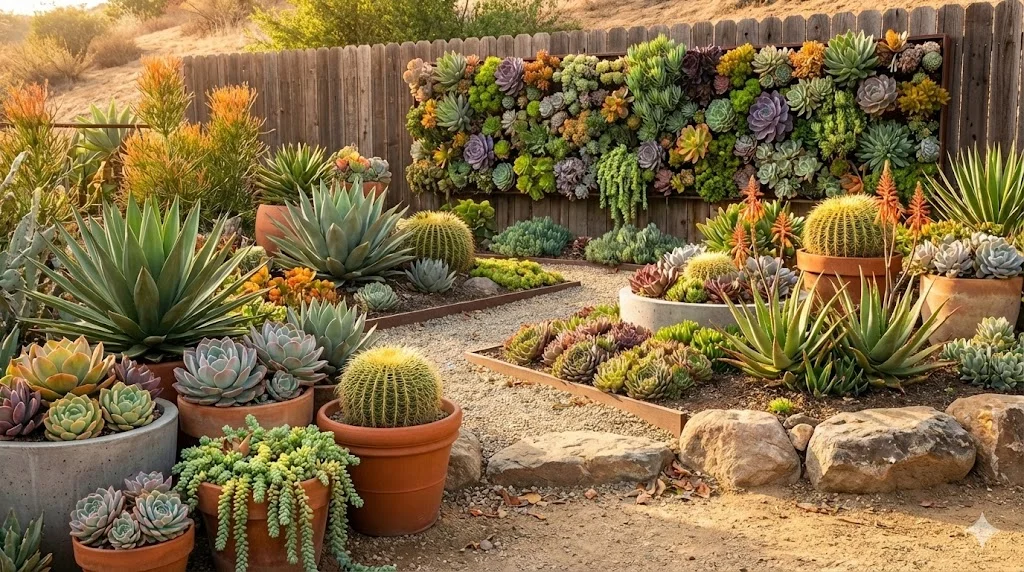
Succulent Garden Design: Drought-Proof Beauty That Lasts All Year
Few plants reward a gardener so generously for so little effort. Succulents store water in their leaves, stems, and roots, which means they thrive in conditions that would stress most perennials — blazing sun, lean soil, weeks without rain. But the real reason succulent garden design has captured the imagination of gardeners everywhere is not just toughness. It is the astonishing range of color, form, and texture these plants deliver, from the jewel-toned rosettes of echeveria to the bold architectural silhouettes of agave and aloe.
Whether you are designing a sun-drenched gravel garden, filling a collection of terracotta pots on a balcony, or building a living wall that turns a blank fence into a tapestry of color, succulents give you a palette that no other plant group can match. This guide covers everything you need to know — from choosing the right succulent families and designing with color to soil preparation, container selection, living wall construction, cold-hardy varieties, and seasonal care.
For a wider perspective on how succulent landscaping fits within the full spectrum of garden styles, see our complete guide to garden design styles.
Types of Succulent Gardens
Succulent garden design is remarkably flexible. The same plants that carpet a hillside in a Mediterranean climate can thrive in a shallow bowl on a windowsill. The key is matching the planting style to your space, climate, and ambitions.
Ground-Level Succulent Gardens
A ground-level succulent garden — planted directly into amended soil or gravel — is the most naturalistic option and works beautifully in dry, sunny locations. Think of broad sweeps of sedum groundcover punctuated by specimen agaves, with rosettes of echeveria and sempervivum tucked between stones. The effect is somewhere between a rock garden and a living mosaic. Ground-level planting is ideal for slopes, raised beds, and areas where turf has failed or been deliberately removed to save water.
Container Succulent Gardens
Containers are the gateway to succulent gardening. A single wide bowl planted with a carefully chosen selection of rosettes, trailers, and upright forms can be as satisfying as a full border. Containers also let you grow tender species in cold climates — simply move them under cover when frost threatens. Group pots of different sizes and materials for the most impact, and treat each container as a miniature garden with its own composition of height, color, and texture.
Living Walls
Living walls — vertical panels or frames planted with succulents — are one of the most striking uses of these plants. Because succulents are shallow-rooted and lightweight, they adapt brilliantly to vertical planting. A living wall can transform a bare fence, garage wall, or courtyard boundary into a living artwork. The geometric regularity of rosette-forming succulents makes them particularly effective in vertical arrangements, where the pattern of repeating forms reads beautifully from a distance.
Green Roofs
Sedum and sempervivum are the plants of choice for extensive green roofs — lightweight, low-maintenance, and tolerant of the extreme conditions found on rooftops. A green roof planted with a mix of sedum species provides year-round cover, insulates the building, manages stormwater, and supports pollinators. While green roof engineering is a specialist subject, the planting principles are the same as any succulent garden: sharp drainage, lean substrate, and full sun.
Succulent Families: Choosing Your Palette
The diversity within the succulent world is enormous. Understanding the key families helps you design with intention rather than impulse.
Echeveria
Echeveria is the darling of succulent garden design, and for good reason. These rosette-forming plants from Mexico come in an extraordinary range of colors — powder blue, dusty pink, coral, plum, silver-green, and near-black. Their symmetrical form is inherently decorative, and they look stunning grouped in containers or massed in ground displays. Most echeveria are frost-tender, so in cold climates they are best treated as container plants that come indoors for winter.
Sedum (Stonecrop)
Sedum is the backbone of hardy succulent landscaping. The genus includes everything from tiny creeping groundcovers barely two centimeters (one inch) tall to upright border perennials reaching sixty centimeters (two feet). Low-growing sedums — Sedum acre, Sedum album, Sedum spurium — are perfect for filling gaps between paving stones, carpeting rock gardens, and covering green roofs. Taller varieties like Sedum spectabile bring late-summer flower heads that butterflies adore. Many sedums are hardy to minus thirty degrees Celsius (minus twenty-two degrees Fahrenheit) and ask for nothing more than sun and drainage.
Sempervivum (Houseleek)
Sempervivum is the ultimate cold-hardy succulent. These tight rosettes are native to the mountains of Europe and tolerate brutal cold, wind, and drought with equal indifference. They spread by producing offsets — "hens and chicks" — creating dense mats that are ideal for rock crevices, stone troughs, and living walls. Colors range from bright green to deep burgundy, often with contrasting tips or a cobweb-like covering of fine hairs.
Aeonium
Aeoniums bring dramatic form to succulent garden design. Their rosettes sit atop bare, branching stems, creating an almost tree-like silhouette in miniature. The dark, near-black foliage of Aeonium arboreum 'Zwartkop' is one of the most striking contrasts you can plant alongside pale echeveria or silver sedum. Aeoniums are winter-growing, summer-dormant plants, which makes them unusual in the succulent world — they look their best in the cooler months and may go dormant and drop lower leaves in peak summer heat.
Agave
Agave is the sculptural anchor of any succulent landscape. These bold, architectural plants form large rosettes of thick, pointed leaves — some smooth and blue-grey, others armed with fierce marginal teeth. A single mature agave can be a focal point for an entire garden. Smaller species like Agave parryi and Agave victoriae-reginae work well in containers and raised beds. Agaves are generally tender, but a handful of species tolerate temperatures down to minus fifteen degrees Celsius (five degrees Fahrenheit) with good drainage.
Aloe
Aloe brings warm-season flowers to the succulent garden — tubular blooms in vivid orange, red, coral, and yellow that attract hummingbirds and bees. The foliage is handsome year-round, with many species displaying spotted or striped patterns. Aloe polyphylla, the spiral aloe, is one of the most visually dramatic plants in cultivation. Most aloes are frost-tender, but smaller species adapt well to container culture.
Designing with Color: The Echeveria Color Wheel
One of the great pleasures of succulent garden design is painting with living color. Echeveria alone spans a color wheel from cool blue-greens through dusty pinks, warm corals, deep plums, and silvery mauves. When you add the chartreuse of sedum, the near-black of certain aeoniums, and the blue-grey of agave, you have a palette as rich as any perennial border.
A few principles for working with succulent color:
- Analogous harmonies — grouping colors that sit next to each other on the wheel — create calm, cohesive compositions. Try dusty pink echeveria alongside mauve and silver-blue varieties for a soft, tonal effect.
- Complementary contrasts — pairing opposites on the wheel — produce energy and drama. Set a deep plum echeveria against chartreuse sedum, or a coral rosette against blue-grey agave foliage.
- Value contrast is just as important as hue. Place pale, silvery succulents against dark aeoniums or rich burgundy sempervivum to make both read clearly.
- Stress coloring is a bonus. Many succulents intensify in color when exposed to more sun, cooler temperatures, or drier conditions. An echeveria that is green in shade may blush to deep pink in full sun. Design with this in mind — the most exposed positions will often produce the most vivid color.
When planning your succulent color schemes, it helps to lay out plants side by side before committing to a final arrangement. Colors shift depending on their neighbors, and what looks harmonious in isolation may clash or disappear in context.
Texture and Form Combinations
Succulent garden design is not just about color. The interplay of texture and form is what separates a thoughtful composition from a random collection.
- Rosettes (echeveria, sempervivum, aeonium) provide repeating geometric pattern and visual rhythm.
- Spikes and spears (agave, aloe, senecio) create vertical energy and contrast with rounded forms.
- Trailing forms (string of pearls, burro's tail, trailing sedum) soften edges and cascade over pot rims, walls, and raised beds.
- Mounding groundcovers (sedum, delosperma) fill gaps and provide a living carpet between larger specimens.
- Columnar and branching forms (aeonium, crassula) add height and architectural interest.
The most effective succulent compositions combine at least three contrasting forms — a focal rosette or spear, a supporting mound or cluster, and a trailing element — at different scales. This "thriller, filler, spiller" principle, borrowed from container gardening, applies equally to ground-level beds and living walls.
Soil and Drainage Requirements
Drainage is the single most important factor in succulent garden design. Succulents store water in their tissues and will tolerate extreme drought, but they cannot survive waterlogged roots. Every element of your soil preparation should focus on moving water through and away.
Soil Mix for Containers
A good container mix for succulents is roughly equal parts of potting compost, coarse perlite or pumice, and sharp grit or coarse sand. The result should feel gritty and open, draining freely when watered. Avoid peat-heavy mixes that hold moisture for too long. Purpose-made succulent and cactus composts are widely available and work well as a base, though adding extra perlite never hurts.
Soil Preparation for Ground Planting
In the garden, amend heavy or clay soil by digging in generous amounts of grit and coarse sand to a depth of at least thirty centimeters (twelve inches). Raised beds are the most reliable solution for difficult soil — build them twenty to thirty centimeters (eight to twelve inches) above grade and fill with a free-draining mix. Gravel mulch over the soil surface keeps the crowns of succulents dry and further improves drainage at the surface.
The Importance of the Drainage Layer
In containers without a large drainage hole, a layer of coarse gravel or broken crocks at the base helps prevent the bottom of the pot from becoming a water reservoir. In living walls and vertical planters, the drainage matrix is built into the structure — typically a rigid panel with pockets or a geotextile envelope that holds the substrate while allowing water to drain downward.
Container Design: Materials and Composition
The choice of container matters enormously in succulent garden design. The pot is part of the composition, framing and enhancing the plants it holds.
Terracotta
Terracotta is the classic choice for succulents. Its warm, earthy tones complement virtually every succulent color, from cool blue-grey to warm coral. Unglazed terracotta is porous, which means it breathes and dries out faster than plastic or glazed ceramic — a real advantage for succulents that resent sitting in wet soil. Over time, terracotta develops a patina of mineral salts and moss that adds character.
Concrete and Hypertufa
Concrete and hypertufa containers bring a modern, sculptural quality to succulent displays. Their neutral grey tones are a perfect foil for colorful echeveria and the dark drama of aeonium. Hypertufa — a mixture of cement, perlite, and peat — can be cast in custom shapes and develops a weathered, stone-like texture that looks beautifully aged within a season.
Driftwood and Natural Vessels
Hollowed driftwood, sections of weathered tree trunk, and even large seashells make striking succulent planters. The organic texture of wood against the architectural precision of rosettes creates a wonderful contrast. Because these vessels rarely have drainage holes, line them with a layer of gravel and use a very fast-draining mix. They are best suited to small, shallow-rooted succulents like echeveria, sempervivum, and small sedum.
Grouping and Arrangement
Group containers in clusters of odd numbers — three, five, or seven — at different heights. Use a mix of pot sizes and shapes, but keep the material palette cohesive (for example, all terracotta, or all concrete). Elevate some pots on stands or upturned pots to create layers and give trailing succulents room to cascade.
Living Wall Construction
A succulent living wall is one of the most rewarding projects in garden design. The shallow root systems and low water needs of succulents make them ideal for vertical planting, and the repeating geometry of rosettes creates a mosaic effect that is endlessly captivating.
Frame and Panel Systems
The simplest approach is a shallow wooden frame — like a picture frame with a backing board and a wire mesh or hardware cloth front — filled with succulent potting mix. Cuttings or small rooted plants are pushed through the mesh into the soil. The frame is laid flat for four to six weeks while roots establish, then hung vertically. Prefabricated living wall panels with individual pockets or modular cells are also available and simplify larger installations.
Irrigation for Vertical Planting
Vertical planting dries out faster than ground-level beds. A simple drip irrigation line running across the top of the wall, with water trickling down through the substrate by gravity, is the most reliable watering method. In small frames, hand-watering from the top with a gentle stream works well. Water when the substrate feels dry to the touch — overwatering is a greater risk than underwatering with succulents.
Plant Selection for Living Walls
Choose compact, shallow-rooted species for living walls. Sempervivum, small echeveria, sedum, and small crassula are ideal. Avoid large agaves or heavy trailing plants that may pull away from the wall. Plant tightly — the tighter the planting, the more stable the wall and the more dramatic the mosaic effect. Mapping out your living wall design before planting helps you achieve balanced color and form across the entire panel.
Hardy Succulents for Cold Climates
One of the most common misconceptions about succulents is that they are strictly warm-climate plants. In reality, several genera are among the hardiest perennials you can grow.
Sempervivum
Sempervivum species and hybrids are reliably hardy to minus thirty degrees Celsius (minus twenty-two degrees Fahrenheit) and below. They are native to alpine conditions — rocky, exposed, and frozen for months at a time. The key to their survival in cold, wet climates is drainage. In heavy soil, grow them in gravel, stone troughs, or the gaps in dry stone walls where their roots stay dry even in the wettest winter.
Hardy Sedum
Many sedum species are equally tough. Sedum acre, Sedum album, Sedum reflexum, and Sedum spurium tolerate brutal cold and spread to form dense, weed-suppressing mats. Taller varieties like Sedum spectabile and Sedum telephium are staples of herbaceous borders in cold climates, providing structure and late-season color long after other perennials have faded.
Jovibarba and Orostachys
For collectors and rock garden enthusiasts, the genera Jovibarba (closely related to sempervivum) and Orostachys (a rosette-forming plant from Central Asia) offer additional cold-hardy options with unusual forms and textures. Both thrive in the same sharp-draining conditions as sempervivum.
Protecting Borderline-Hardy Succulents
For succulents that are marginally hardy in your zone — many echeveria, some aloes, and certain agaves — a gravel mulch over the crown, a position against a sun-warmed wall, and protection from winter wet can extend their range by one or two hardiness zones. A simple cloche or pane of glass propped over the plant to deflect rain, while allowing air circulation, can make the difference between loss and survival.
Propagation Basics
Succulents are among the easiest plants to propagate, making them ideal for gardeners who want to expand their collection or share plants with friends.
Leaf Propagation
Many succulents — especially echeveria, sedum, and graptopetalum — can be propagated from individual leaves. Gently twist a healthy leaf from the stem, making sure the base of the leaf comes away cleanly. Lay the leaf on dry succulent mix in a tray and leave it in bright, indirect light. Within a few weeks, tiny roots and a new rosette will emerge from the base of the leaf. Resist the temptation to water until roots are visible.
Offsets and Division
Sempervivum, agave, aloe, and many other succulents produce offsets — baby plants that emerge from the base of the parent. These can be separated with a clean cut and planted directly into their own pot or position. Offsets are the fastest route to new plants, often reaching flowering size within a season.
Stem Cuttings
Branching succulents like aeonium, crassula, and sedum are easily propagated from stem cuttings. Cut a healthy stem, allow the cut end to dry and callous for two to three days, then push it into gritty compost. Water sparingly until new growth indicates that roots have formed. Stem cuttings are the best way to rejuvenate leggy or overgrown plants while producing new stock at the same time.
Seasonal Care
Succulent garden design rewards you with low maintenance, but a little seasonal attention keeps plants looking their best.
Spring
Spring is the main growing season for most succulents. Gradually increase watering as temperatures rise. This is the ideal time to repot container plants into fresh mix, separate offsets, and take leaf or stem cuttings. Feed container-grown succulents with a dilute, low-nitrogen fertilizer once a month through the growing season.
Summer
In hot climates, some succulents — particularly aeoniums and certain sedums — may go semi-dormant in peak summer. Reduce watering for dormant species and provide afternoon shade if temperatures regularly exceed thirty-eight degrees Celsius (one hundred degrees Fahrenheit). Keep an eye out for mealybugs and aphids, which are most active in warm weather.
Autumn
Autumn is the time to prepare for winter. Move frost-tender container plants to a sheltered position or indoors before the first frost. In the ground, apply a gravel mulch around the crowns of borderline-hardy plants. Stop feeding container plants — new growth prompted by fertilizer is soft and vulnerable to cold.
Winter
Hardy succulents like sempervivum and sedum require no winter protection beyond good drainage. Tender species overwintering indoors need a cool, bright position and very sparing water — just enough to prevent the leaves from shriveling. Avoid warm, dark rooms, which encourage etiolation (stretching toward light).
Combining Succulents with Gravel and Stone
Succulents and mineral landscapes belong together. The contrast of living, colored rosettes against the neutral backdrop of gravel and stone is one of the most satisfying effects in garden design.
Gravel Gardens
A gravel garden planted with succulents follows the same principles as any dry garden. Lay a weed-suppressing membrane over prepared soil, cut planting holes, set in your succulents, and top-dress with a layer of gravel five to eight centimeters (two to three inches) deep. Choose gravel that complements your plant palette — warm buff or honey tones for pink and coral succulents, cool grey or slate for blue-green and silver varieties.
Rock Gardens and Stone Troughs
Rock gardens are a natural home for alpine succulents. Sempervivum, sedum, and jovibarba look as though they have always been there when planted in crevices between rocks. Stone troughs — genuine or cast from hypertufa — make perfect miniature succulent landscapes, bringing the plants up to eye level and providing the sharp drainage they crave.
Stepping Stones and Paving Gaps
Low-growing sedum and sempervivum are ideal for planting between stepping stones and in the gaps of crazy paving. They tolerate light foot traffic, suppress weeds, and soften the hard lines of paving with a living carpet of color and texture. Plant creeping sedum varieties in the joints of a gravel path for a result that is both practical and beautiful.
This style of drought-adapted planting has much in common with other water-wise approaches. If you are drawn to the broader principles of designing with dry-climate plants, our guides to desert and xeriscape garden design and rock garden design with alpine stone explore complementary ideas and plant palettes.
Getting Started
The beauty of succulent garden design is that it scales to any ambition. You can start with a single terracotta bowl of echeveria on a sunny doorstep and expand from there — adding a stone trough of sempervivum, a gravel bed with agave and sedum, or a living wall that becomes the centerpiece of your outdoor space. The plants are forgiving, the materials are accessible, and the results are almost immediate.
Begin with good drainage, choose plants that suit your climate, and let the extraordinary diversity of succulents do the rest. Whether you are building a miniature tabletop garden or reimagining an entire front yard, succulent landscaping delivers color, texture, and beauty with a fraction of the water and effort that traditional planting demands. That is a bargain any gardener can appreciate.
Garden Design Team
Expert garden designers sharing tips, inspiration, and practical advice for creating beautiful outdoor spaces.
Explore professional garden design
Gardenly3D is a paid professional garden-design application. See plans for included capabilities and availability.
Join the waitlistRelated articles
Garden Design Styles: The Complete Guide
Explore every major garden design style from cottage to Japanese, modern to Mediterranean. Find the perfect style for your space, climate, and taste.
Coastal Garden Design: Salt-Tolerant Beauty
Design a beautiful coastal garden that thrives in salt spray, wind, and sandy soil. Discover the best seaside garden plants and design techniques for exposed sites.
Cottage-Style Front Garden: Welcoming and Colorful
Transform your front garden into a welcoming cottage paradise with climbing roses, flower-lined paths, and seasonal color. Design tips for maximum curb appeal.