
How to Plan a Low-Maintenance Garden
Learn how to plan a low-maintenance garden with smart plant choices, mulching strategies, hardscape ratios, and automated irrigation for less weekly effort.
How to Plan a Low-Maintenance Garden
Low maintenance does not mean low beauty. Some of the most stunning gardens in the world require very little regular care -- they are simply designed intelligently. The secret is making smart decisions at the design stage that eliminate recurring work rather than trying to reduce maintenance in a garden that was designed to need it.
A high-maintenance garden demands weekly weeding, frequent watering, regular deadheading, constant pruning, and seasonal replanting. A well-planned low-maintenance garden needs a thorough seasonal tidy twice a year, occasional pruning, and very little else. The difference is not in how hard you work -- it is in the design decisions you make upfront. This guide shows you how to make those decisions. For the complete garden design process, see our beginner's guide to designing a garden from scratch.
The Five Pillars of Low Maintenance
Every low-maintenance garden is built on these five principles:
- Right plant, right place -- Plants that suit their conditions do not need coddling
- Soil covered at all times -- Bare soil grows weeds; covered soil does not
- Hard landscape that cleans itself -- Materials that do not need annual treatment
- Water delivered automatically -- Irrigation that runs without you
- Simplified lawn or no lawn -- Lawn is the most maintenance-intensive feature in most gardens
Master these five principles and your weekly maintenance drops dramatically.
Hardscape Ratio: More Surface, Less Work
The simplest way to reduce maintenance is to increase the proportion of hard landscape relative to planting. This does not mean paving over your garden -- it means being strategic about where hard surfaces go.
A typical high-maintenance garden might be 20% hard surface and 80% planted. A low-maintenance garden might be 40-50% hard surface and 50-60% planted. The extra hard surface comes from:
- A generously sized patio that does not need extending
- Gravel areas that replace lawn in spaces you do not walk on
- Wider paths that reduce the amount of bed edge to maintain
- A single, well-shaped lawn rather than multiple grass areas with fiddly edges
The key is to make hard surfaces beautiful rather than functional-looking. A large gravel garden with specimen plants is far more attractive than a concrete yard. For patio design guidance, see how to design a patio.
A low-maintenance garden should look like a deliberate design choice, not a compromise. The best ones are more beautiful than their high-maintenance counterparts because every element has been chosen with intention.
Plant Selection for Minimal Care
Choosing the right plants eliminates most garden maintenance. Here is what to look for:
Characteristics of Low-Maintenance Plants
- Drought-tolerant once established: Needs no supplementary watering after the first year
- Disease-resistant: Does not require spraying or special treatment
- Slow-growing or naturally compact: Needs infrequent pruning
- Long-lived: Does not need replacing every few years
- Self-cleaning: Drops spent flowers naturally without deadheading
- Good foliage: Looks attractive even when not in flower
Reliable Low-Maintenance Plant Categories
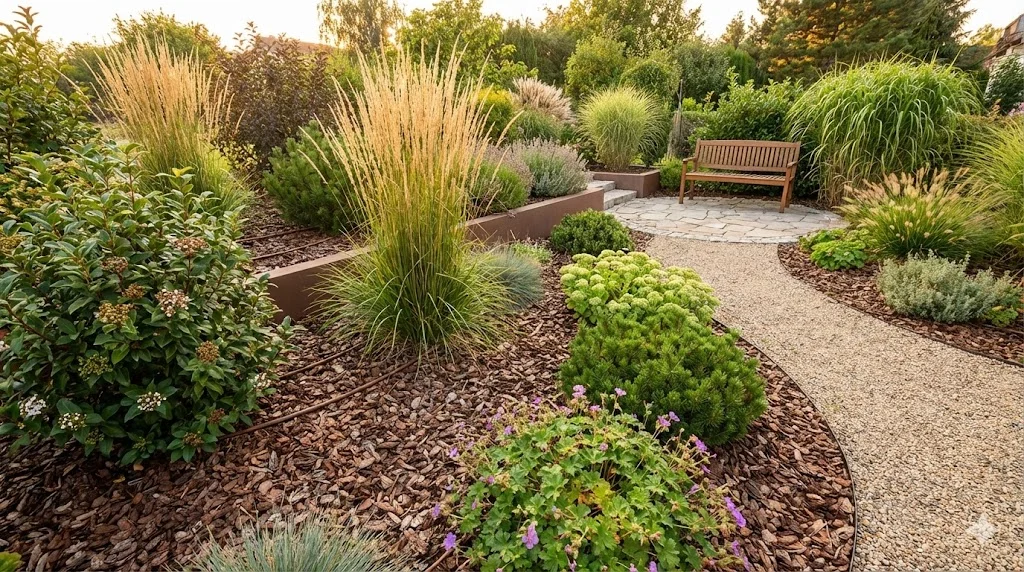
Ornamental grasses: Miscanthus, Stipa, Calamagrostis, Pennisetum. Beautiful from summer through winter. Cut back once in late February. No other care needed.
Evergreen shrubs: Viburnum tinus, Choisya, Sarcococca, Pittosporum. Provide year-round structure. Prune once a year at most.
Ground-cover perennials: Geranium macrorrhizum, Alchemilla mollis, Epimedium, Bergenia. Cover soil, suppress weeds, and spread to fill gaps.
Tough perennials: Sedum, Rudbeckia, Echinops, Achillea, Nepeta. Flower for weeks, need no staking, and tolerate drought.
Self-seeding annuals: Nigella, Verbena bonariensis, Eschscholzia. Appear every year without replanting.
Plants to Avoid in Low-Maintenance Gardens
- Hybrid tea roses (need constant pruning, feeding, and spraying)
- Dahlias (need lifting, storing, and replanting annually in cold climates)
- Annual bedding (needs replacing every season)
- Fast-growing hedges like Leyland cypress (need cutting three or four times a year)
- Wisteria (needs careful pruning twice a year to flower well)
Mulching: The Maintenance Eliminator
Mulch is the single most effective tool for reducing garden maintenance. A 7-10 cm (3-4 inch) layer of organic mulch over all bare soil:
- Suppresses annual weed seeds by blocking light
- Retains soil moisture, reducing watering needs by up to 70%
- Regulates soil temperature, protecting roots from extremes
- Feeds the soil as it decomposes
- Creates a clean, finished appearance
Best Mulch Materials
- Bark chips: Long-lasting, attractive, widely available. Best for borders and around shrubs.
- Composted wood chip: Breaks down faster than bark, improving soil. Good for perennial beds.
- Gravel: Does not decompose, does not harbor slugs, gives a Mediterranean feel. Lay over landscape fabric for maximum weed suppression.
- Leaf mold: Free if you compost your autumn leaves. Excellent soil conditioner.
Apply mulch in spring after the soil has warmed. Top up annually where it has thinned. Keep mulch away from plant stems to prevent rot.
Simplifying or Eliminating Lawn
Lawn is the most time-consuming feature in most gardens. Weekly mowing, edge trimming, feeding, aerating, scarifying, weed treatment, watering in dry spells -- a traditional lawn demands more regular attention than any other garden element.
Options for Reducing Lawn Maintenance
Reduce lawn size: Replace lawn in areas you do not actively use with gravel, ground cover, or planting beds.
Simplify lawn shape: Complex shapes with tight curves, narrow strips, and awkward corners make mowing difficult. A simple rectangle or oval is faster and easier.
Choose low-maintenance grass mixes: Some grass seed mixes are bred for slower growth, drought tolerance, and reduced mowing. Clover-grass mixes fix their own nitrogen and stay green with less water.
Use a robot mower: Automated mowers maintain the lawn continuously without your involvement. They work best on simple, relatively flat lawns.
Replace lawn entirely: In small gardens, replace lawn with a combination of paving, gravel, and planting. Many gardens look better without a lawn.
Automated Irrigation
Hand-watering is time-consuming and inconsistent. An automated irrigation system with a timer or smart controller waters your garden perfectly while you do nothing. For a detailed guide to planning irrigation, see how to plan garden irrigation.
In a low-maintenance garden, drip irrigation through borders and beds is ideal. It delivers water directly to roots, reduces weed germination (dry surface soil does not encourage weed seeds), and is invisible under mulch.
Self-Maintaining Ecosystems
The most sophisticated low-maintenance gardens work with nature rather than against it. These principles help:
- Encourage beneficial insects by planting for pollinators -- ladybirds and hoverflies control aphids naturally
- Let fallen leaves lie in beds and borders where they act as natural mulch and feed the soil
- Plant densely so mature plants cover all soil and outcompete weeds
- Avoid rigid tidiness -- a slightly relaxed garden with standing seed heads and grasses is both more beautiful and more ecologically productive than a manicured space
Design Layout for Easy Access
Think about maintenance access as part of your design:
- Can you reach the middle of every border without stepping on plants? If a bed is deeper than 1.5 meters (5 feet), consider a stepping-stone path through the back.
- Is there a clear route for wheelbarrows to reach every part of the garden?
- Are compost bins accessible without navigating obstacles?
- Can you reach every hedge face for the annual trim?
You can map out access routes in your garden plan to ensure that practical maintenance needs are built into the design from the start.
A Sample Low-Maintenance Planting Plan
For a typical suburban border (4 meters wide, 10 meters long / 13 x 33 feet):
Back row (structure and height):
- 3 x Miscanthus sinensis 'Morning Light' (ornamental grass)
- 2 x Viburnum tinus (evergreen shrub)
Middle row (color and texture):
- 5 x Sedum 'Herbstfreude' (Autumn Joy)
- 3 x Rudbeckia fulgida
- 5 x Nepeta 'Six Hills Giant' (catmint)
Front row (ground cover and edging):
- 7 x Geranium macrorrhizum
- 5 x Alchemilla mollis
Bulbs (woven through):
- 50 x Narcissus 'Thalia' (spring)
- 30 x Allium 'Purple Sensation' (late spring)
This border provides interest from March to November, requires cutting back once in late winter, and needs no staking, spraying, or deadheading.
Getting Started
Assess your current garden honestly. Which tasks take the most time each week? Those are the areas to redesign first. For most people, it is lawn care and weeding. Reduce the lawn, mulch the beds, and plant ground cover -- three changes that can halve your maintenance time within one season.
For the complete garden design process, return to our beginner's guide to designing a garden from scratch.
Garden Design Team
Expert garden designers sharing tips, inspiration, and practical advice for creating beautiful outdoor spaces.
Explore professional garden design
Gardenly3D is a paid professional garden-design application. See plans for included capabilities and availability.
Join the waitlistRelated articles
Backyard Garden Design: Creating Your Outdoor Sanctuary
Design a backyard that works as an outdoor living space. Zoning for dining, relaxation, and play, with privacy screening and year-round planting.
Balcony Garden Design: Growing in Containers
Create a thriving balcony garden with smart container choices, wind-resistant plants, vertical systems, and self-watering solutions for high-rise growing.
Corner Lot Garden Design: Two-Sided Curb Appeal
Design a corner lot garden that impresses from both streets. Dual frontage planting, visibility sightlines, wraparound beds, and privacy from two directions.