
Courtyard Garden Design: Enclosed Outdoor Rooms
Design a stunning courtyard garden that feels like an outdoor room. Container planting, water features, shade solutions, and Mediterranean inspiration.
Courtyard Garden Design: Enclosed Outdoor Rooms
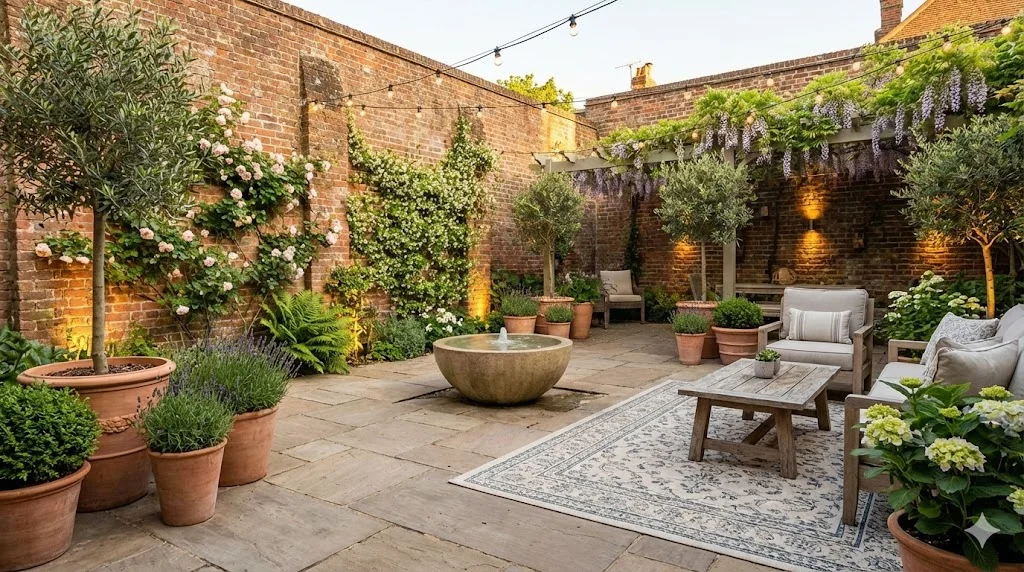
A courtyard is a garden defined by its boundaries. Where a conventional plot stretches outward into hedges or fences, a courtyard is held in place by walls -- the walls of a house, a neighbouring building, a boundary structure, or some combination of all three. That enclosure changes everything about how the space feels, how light moves through it, and what you can grow. It also gives you something that open gardens rarely achieve: the sense of being in an outdoor room.
Courtyard gardens have a lineage stretching back thousands of years. The Romans built their homes around planted atriums. Moorish palaces in Andalusia centred on water-filled courtyards cooled by fountains and shaded by citrus trees. What all these designs share is a recognition that enclosure is not a constraint -- it is the defining feature. The walls create shelter, intimacy, and a microclimate that allows plants to thrive in ways they could not in an exposed setting.
This guide covers everything you need to create a courtyard garden that works as a genuine outdoor room. If you are working with a broader range of space types, our guide to garden design for any space provides a wider framework that complements the courtyard-specific advice here.
Why Courtyards Are Unique: The Microclimate Advantage
The most important thing to understand about courtyard garden design is the microclimate. Walls absorb heat during the day and release it slowly through the evening. This thermal mass effect means courtyard temperatures are typically two to four degrees warmer than surrounding open ground, especially overnight. In temperate climates, that difference extends the growing season by weeks and allows you to grow plants that would struggle in an exposed border.
South-facing walls can create conditions comparable to a garden one full hardiness zone warmer. Trachelospermum jasminoides (star jasmine), which sulks in many British gardens, will flourish against a warm courtyard wall. The same goes for Citrus limon, figs, and other borderline-hardy species that benefit from reflected warmth and shelter from wind.
Wind protection is the other major advantage. Even in an urban setting where gusts funnel between buildings, a properly enclosed courtyard offers stillness. Plants that snap or scorch in exposed conditions -- tall grasses, delicate ferns, papery-petalled flowers -- hold their form beautifully in sheltered air.
The trade-off is light. Walls cast shadows, and in smaller courtyards those shadows can dominate for much of the day. Spend a full day noting where sunlight falls at two-hour intervals, and you will have a map that guides every decision that follows.
Choosing Floor Surfaces
The floor of a courtyard carries visual weight that it rarely does in a larger garden. In an open plot, your eye moves across lawn, borders, and distant views. In a courtyard, the floor is always in your peripheral vision. Choosing the right surface sets the entire tone.
Natural stone -- limestone, sandstone, or slate -- ages gracefully in enclosed spaces. Large-format pavers reduce the number of joints and make a small courtyard feel more spacious. Avoid mixing too many stone types; one material in a consistent format creates calm.
Terracotta and clay pavers bring warmth to cooler, north-facing courtyards. Their earthy tones complement planting beautifully and pair naturally with Mediterranean courtyard traditions.
Gravel works well as a secondary surface, filling gaps between planted areas or forming a permeable base around a central feature. Avoid bright white gravel in small courtyards -- it creates harsh glare under direct sun.
Poured concrete or resin-bound aggregate suits modern courtyard designs. A smooth, pale concrete floor bounces light into shaded corners and provides a clean backdrop for architectural planting.
Whichever surface you choose, consider drainage carefully. Courtyards are essentially bowls, and without proper falls and drainage channels, rainwater has nowhere to go. A slight gradient toward a central drain or a permeable border strip prevents waterlogging.
Container Planting: The Courtyard Workhorse
Containers are not a compromise in a courtyard garden -- they are the primary planting strategy. Courtyards often sit on solid surfaces with no planting beds at all. Containers bring soil, structure, and seasonal change into the space without altering the fabric of the building.
The key to successful courtyard container planting is thinking in layers:
- Tall structural containers -- large pots holding small trees or tall grasses that create a canopy layer and vertical emphasis. Olea europaea (olive), Prunus lusitanica (Portuguese laurel), and multi-stemmed Amelanchier all thrive in large containers.
- Mid-height planting -- containers at 40--60cm holding shrubs, perennials, or herbs that form the backbone of the planting scheme. Lavender, rosemary, Pittosporum tobira 'Nanum', and box balls all work well.
- Low and trailing containers -- smaller pots and troughs at floor level or on low walls, filled with trailing Hedera, Vinca minor, or seasonal bedding for colour.
- Wall-mounted containers -- brackets, troughs, or pocket planters fixed to walls, adding a vertical planting dimension without consuming floor space.
Group containers in odd numbers. Three or five pots of varying heights clustered together create a more natural composition than evenly spaced matching containers. Repeat the same pot material -- terracotta, zinc, or concrete -- to unify the scheme.
Watering is the main maintenance challenge. Courtyard walls create rain shadows, and containers dry out faster than ground-planted beds. A simple drip irrigation system connected to an outdoor tap transforms container care from a daily chore to a weekly check. When planning your courtyard layout, mapping container positions alongside sun exposure and water access helps you avoid placing thirsty plants in the driest corners.
Shade-Tolerant Plants for Walled Spaces
Every courtyard has shade. Even a south-facing courtyard with low walls will have pockets where direct sun never reaches. Rather than fighting this, embrace it. Some of the most elegant courtyard planting schemes are built entirely around shade-tolerant species.
For walls, climbing plants soften hard surfaces and add maturity within a single season. Hydrangea anomala subsp. petiolaris (climbing hydrangea) is self-clinging and thrives on north-facing walls. Trachelospermum jasminoides handles partial shade and contributes intoxicating evening fragrance. For deep shade, Hedera helix varieties -- 'Glacier', 'Green Ripple' -- provide year-round green.
At ground level, ferns are the courtyard gardener's best friend. Dryopteris erythrosora (autumn fern) opens with coppery fronds that mature to green. Asplenium scolopendrium (hart's tongue fern) offers bold, undivided leaves. Polystichum setiferum (soft shield fern) brings a lacy delicacy that catches every breath of air.
Combine ferns with shade-tolerant perennials such as Brunnera macrophylla 'Jack Frost', Hakonechloa macra, and Epimedium species for tough, weed-suppressing ground cover. In deeper shade, Fatsia japonica provides bold, architectural leaves year-round.
For more ideas on thriving in limited light, many of the strategies in our guide to designing a small garden that feels bigger translate directly to shaded courtyard planting.
Wall-Mounted Planting and Vertical Green
Walls are the defining feature of a courtyard, and leaving them bare is a missed opportunity. Vertical planting transforms hard surfaces into living architecture and increases the planted area without consuming floor space.
Climbing plants on wires or trellis are the simplest approach. Stainless steel wire systems fixed in horizontal runs 30--40cm apart allow climbers to cover a wall evenly. Wisteria, jasmine, roses, and clematis all perform well on wire supports.
Green wall panels offer a more structured approach. Modular pocket systems can be fixed to any sound wall and planted with ferns, sedums, herbs, or trailing perennials. They require irrigation and regular feeding but create a striking effect.
Espalier and fan-trained fruit trees bring a productive dimension to courtyard walls. A fan-trained fig, a cordon apple, or an espalier pear turns a blank wall into a beautiful and edible feature. Courtyard microclimates are often ideal for fruit, providing the warmth that helps stone fruit ripen reliably.
Hanging planters and wall-mounted troughs fill the middle zone between floor containers and overhead climbers. Arrange them at staggered heights for a rhythmic vertical composition.
Water Features for Enclosed Spaces
Water belongs in a courtyard. Enclosed walls amplify sound, turning even a modest trickle into a soothing focal point. Where road noise and urban hum intrude, a water feature provides white noise that masks distractions and deepens the sense of retreat.
Scale is critical. A large pond overwhelms a small courtyard. Instead, consider:
- Wall-mounted spouts -- a single spout flowing into a shallow trough or raised basin. Simple, architectural, and easy to install.
- Self-contained bowl features -- a stone or zinc bowl with a recirculating pump. Compact enough for the smallest courtyard, and surprisingly effective at creating atmosphere.
- Rill channels -- a narrow channel of flowing water set into the floor surface, inspired by Moorish courtyard design. Rills bring movement and reflection without occupying much space.
- Raised pools -- a low, walled pool with still water that reflects light upward onto courtyard walls. Particularly valuable in shaded courtyards where bouncing light into dark corners makes a noticeable difference.
Keep water features simple to maintain. Enclosed courtyards collect leaf litter, and a feature clogged with debris quickly becomes an eyesore.
Mediterranean Courtyard Inspiration
The Mediterranean courtyard tradition offers the most complete template for enclosed garden design. For centuries, homes across southern Europe and North Africa have been built around central courtyards that serve as the heart of domestic life.
The essential elements translate well to cooler climates:
- Terracotta and warm stone for floors and containers
- Rendered or lime-washed walls in white, cream, or warm ochre to reflect light
- A central water feature -- often a simple fountain or basin
- Aromatic planting -- lavender, rosemary, thyme, Pelargonium, and citrus in pots
- Dappled shade from a vine-covered pergola or a mature tree
- Wrought iron or simple timber furniture for outdoor dining
If this style appeals to you, our Mediterranean garden style guide goes into greater depth on plant choices, materials, and design principles. Many of the container techniques used in balcony garden design also apply directly to Mediterranean courtyard planting.
Even without a fully Mediterranean scheme, borrowing its core principle -- that the courtyard is a room for living, not just a space for plants -- will strengthen any courtyard design.
Lighting Enclosed Spaces
A courtyard that goes dark after sunset is one you only use half the time. Lighting extends the hours you spend in the space and transforms its character. Walls that felt confining during the day become warm and intimate when washed with soft uplighting.
Uplighting placed at the base of walls or behind structural plants creates drama and depth. A single uplight behind a multi-stemmed tree throws branching shadows across the walls that shift with every breeze.
Wall-mounted downlights provide functional light for dining and socialising. Warm-toned LED fittings (2700K--3000K) create a welcoming glow without the harshness of cooler colour temperatures.
Festoon or catenary lights strung across the courtyard at height add a celebratory, relaxed atmosphere. They work particularly well in Mediterranean and informal courtyard styles.
Candlelight and lanterns should not be dismissed. In a sheltered courtyard where wind is minimal, candles in storm lanterns on tables, steps, and wall ledges create an atmosphere that no electric fitting can match.
Avoid overlighting. The magic of a courtyard at night comes from pools of light and areas of soft shadow. If every surface is evenly illuminated, you lose the intimacy that makes enclosed gardens so special. When setting up your courtyard plan, plotting light positions alongside planting ensures the two work together rather than competing.
Bringing It All Together
A courtyard garden succeeds when every element works as a unified composition. Here is a practical sequence for designing yours:
- Map the light. Spend a full day recording sun and shade patterns. This determines plant placement, seating areas, and which walls to prioritise for climbers.
- Choose your floor. Select one primary surface material that sets the tone. Add a secondary material sparingly if needed for contrast or drainage.
- Plan the walls. Decide which walls will carry climbers, which will hold mounted planters, and which will remain bare as a visual rest.
- Position containers. Group them for impact, layer heights for depth, and place the largest pots first as structural anchors.
- Add water. Choose one water feature scaled to the space. Position it where you will hear it from your main seating area.
- Install lighting. Plan for at least three light sources at different heights to create depth and avoid flat, even illumination.
- Furnish for use. Choose furniture that fits the space without crowding it. A bistro table and two chairs often serve a small courtyard better than a full dining set.
The courtyard is the oldest form of designed garden, and it endures because its fundamental idea -- an outdoor room enclosed by walls, enriched with plants, water, and light -- is as powerful now as it was in ancient Rome. Whether you have a tiny urban yard or a generous walled garden behind a period house, the principles are the same. Work with the enclosure, embrace the microclimate, and design the space as a room you want to inhabit. Start by measuring your courtyard and mapping its light. Everything else follows from there.
Garden Design Team
Expert garden designers sharing tips, inspiration, and practical advice for creating beautiful outdoor spaces.
Explore professional garden design
Gardenly3D is a paid professional garden-design application. See plans for included capabilities and availability.
Join the waitlistRelated articles
Backyard Garden Design: Creating Your Outdoor Sanctuary
Design a backyard that works as an outdoor living space. Zoning for dining, relaxation, and play, with privacy screening and year-round planting.
Balcony Garden Design: Growing in Containers
Create a thriving balcony garden with smart container choices, wind-resistant plants, vertical systems, and self-watering solutions for high-rise growing.
Corner Lot Garden Design: Two-Sided Curb Appeal
Design a corner lot garden that impresses from both streets. Dual frontage planting, visibility sightlines, wraparound beds, and privacy from two directions.